
How can a golf course improve digital hospitality for someone visiting its website?
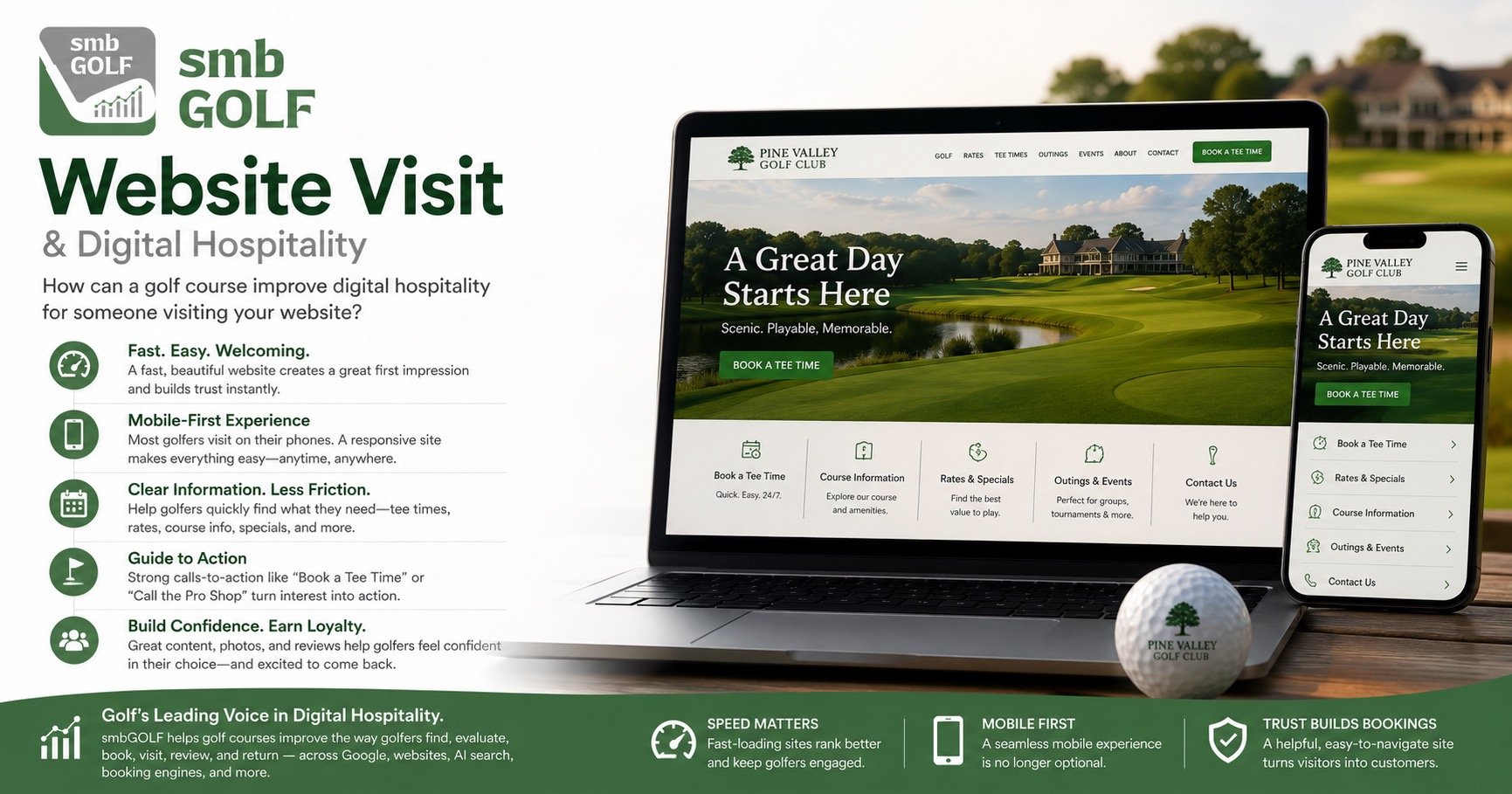
Website visit
A golf course’s website serves as the primary source of truth for nearly every golfer question. It is the anchor of digital hospitality because it is where golfers go when they want to understand the course, check rates, book a tee time, review the scorecard, explore the property, find directions, compare amenities, or decide whether the experience is worth their time and money.
When a website is clear, accurate, fast, and easy to use, it prevents cognitive friction. The golfer does not have to guess, search, pinch, zoom, call, or bounce between disconnected pages to find what they need. Instead, the website creates confidence before the golfer ever steps onto the property.
But the best golf course websites should go beyond basic information. They should create moments of discovery, fun, usefulness, and anticipation.
A great golf course website should not feel like a digital brochure. It should feel like the beginning of the golf experience.
Make the website the ultimate source of truth
A golf course website should answer golfer questions effortlessly. Rates, tee times, scorecards, course policies, hours, directions, dining information, league details, outing information, lesson options, and course updates should be easy to find and current.
One of the biggest opportunities is real-time communication. Courses can use tools like Text-to-Web to post timely updates directly to the website, including frost delays, cart path restrictions, course conditions, weather-related changes, range availability, tournament notices, or last-minute announcements.
This matters because golfers do not want to wonder whether the course is open, whether carts are available, whether the range is closed, or whether a delay is in effect. A hospitable website reduces uncertainty.
Create fun, useful, and unique website experiences
Digital hospitality is not only about removing problems. It is also about creating experiences golfers enjoy.
Golf courses should think about what they can build on the website that makes a golfer say, “That was helpful,” “That was cool,” or “I want to play there.”
A great example is a premium hole-by-hole experience. EagleSticks Golf Club has built a hole-by-hole guide that lets golfers explore the course before they play, study strategy, watch perspectives, and choose where they want to begin the tour. The page is positioned as a complimentary course guide that helps golfers “know the course” and walk to the first tee with more confidence.
That kind of experience does more than fill space on a website. It helps the golfer imagine the round before they arrive.
A premium hole-by-hole experience could include:
Drone video or flyover clips
Pro tips or “golf shop talk”
Best miss and worst miss
Yardages from each tee
Green depth
Elevation notes
Water and bunker details
Photos from the tee, fairway, and green
Strategy for beginners, average golfers, and better players
QR codes on tee signs that take golfers directly to that hole’s page
This is where a website becomes part of the round itself. A golfer waiting on the tee box could scan a QR code and instantly see how to play the hole. That is digital hospitality in the real world.
Build scorecard pages for mobile phones, not desktop monitors
Scorecards are one of the most common pages golfers visit, but many golf course websites still display scorecards as wide images or PDFs that require golfers to pinch, zoom, and scroll left and right on a phone.
That is a bad mobile experience.
A scorecard page should be built vertically, especially for mobile users. Instead of forcing a traditional horizontal card onto a narrow screen, the website should present the information in a format that feels natural on a phone.
A mobile-friendly scorecard page could include:
Front nine and back nine sections stacked vertically
Hole-by-hole rows that are easy to read
Tee yardages clearly separated by color
Par and handicap information visible without side scrolling
Men’s and women’s handicap information clearly labeled
Course rating and slope by tee
Downloadable scorecard option for those who still want the traditional version
A simple “Book a Tee Time” button near the scorecard
Penderbrook Golf Club’s scorecard page is a useful example because it includes scorecard information and connects golfers to a USGA Course Handicap Calculator, giving the page more utility than a basic image or PDF.
That is the right way to think about website hospitality: do not just show the scorecard; help the golfer use it.
Add tools that help golfers plan their round
A website can create value by helping golfers make better decisions.
Examples include:
Handicap calculator
Tee recommendation guide
Pace-of-play expectations
“Which tees should I play?” tool
Course strategy guide
Driving range availability
Weather-aware course alerts
League finder
Outing inquiry form
Gift card purchase page
Golf lesson request form
FAQ pages for first-time visitors
Restaurant menu and patio information
Stay-and-play package planner
These tools create trust because they show the course understands what golfers are trying to do.
The best websites do not just say, “Come play golf here.” They help golfers prepare, decide, book, and enjoy the visit.
Remove friction from the booking engine
The tee time booking engine is often the golfer’s first true transaction with the facility. That makes it one of the most important parts of website hospitality.
A golfer should be able to move from interest to booking without unnecessary obstacles.
Courses should review the booking experience and ask:
Is the booking button easy to find?
Does it work well on a phone?
Are prices clear?
Are available times easy to understand?
Are login requirements truly necessary?
Are fees disclosed early?
Does the golfer know what they are buying?
Is the booking engine fast?
Does the golfer remain in a branded experience, or do they feel sent somewhere unfamiliar?
The booking engine is not just a utility. It is part of the brand experience. If it is slow, confusing, or overly restrictive, the golfer may associate that frustration with the course itself.
Tailor the mobile experience
Responsive design is not enough. A website should not simply shrink the desktop version to fit a phone. It should be designed around how golfers actually use their phones.
On mobile, golfers often want fast answers:
Book a tee time
Call the golf shop
Get directions
Check rates
View the scorecard
See if the course is open
Check restaurant hours
Find the first tee or clubhouse
Look up a hole while standing on the tee box
A strong mobile website should prioritize those actions. A mobile visitor should see clear buttons for Book a Tee Time, Call, Directions, and Scorecard without having to dig through menus.
The scorecard, course guide, rates page, and tee time page should all be built with thumbs, small screens, and outdoor use in mind.
Prioritize speed and security
Website speed is part of hospitality. A slow website tells the golfer the course may not be paying attention to the details.
Golfers are often looking at course websites while sitting in a car, standing outside, walking through a parking lot, or comparing tee times on a mobile connection. Pages should load quickly and feel light.
Courses can improve performance by:
Compressing large images
Using modern image formats
Avoiding unnecessary scripts
Reducing oversized sliders
Limiting heavy third-party widgets
Using fast hosting
Testing important pages on mobile
Security also matters. Every golf course website should use HTTPS. If golfers are booking, buying gift cards, filling out forms, or submitting personal information, they need to feel safe.
Make accessibility part of hospitality
A truly hospitable website is usable by as many people as possible.
Accessibility should not be treated as a technical afterthought. It is part of welcoming golfers. Clear contrast, readable font sizes, keyboard navigation, alt text, properly labeled buttons, logical headings, and accessible forms all make the website better for everyone.
For golf courses, this is especially important because the customer base often includes older golfers who may have vision, mobility, or device-use challenges.
Accessibility is not just compliance. It is good hospitality.
Optimize for Google, AI, and golfer questions
A golf course website should be structured so that Google, AI systems, and human visitors can all understand it.
That means building pages around the real questions golfers ask:
What are your tee times?
What are your rates?
Do you have a driving range?
Do you offer lessons?
Can I host an outing?
Do you have a restaurant?
Are you public or private?
What is the scorecard?
What are the course policies?
Is the course good for beginners?
What makes the course unique?
Golf-specific information architecture matters. A course should have clear pages for tee times, rates, scorecard, course details, hole-by-hole content, leagues, outings, lessons, restaurant, events, and FAQs.
Schema can help search engines and AI systems understand the business, but the content itself still needs to be clear, useful, and accurate.
The bigger point
A great golf course website does more than process transactions.
It welcomes the golfer. It answers questions. It reduces uncertainty. It creates confidence. It helps someone picture the experience before they arrive.
The next generation of golf course websites should combine practical information with memorable digital experiences: premium hole-by-hole guides, mobile-first scorecards, handicap tools, real-time course updates, helpful FAQs, better booking paths, and content that makes the course feel alive.
That is digital hospitality.
It is not just having a website. It is using the website to make every golfer feel more informed, more confident, and more excited to visit.