Digital Hospitality in Golf · Edition 4
Your booking engine already knows why golfers leave. Does your vendor?
Most golf course operators cannot tell you their online tee time conversion rate, and next to none can tell you what actually happens between “landed on the page” and “gave up.” That gap isn’t really an analytics problem — it’s a documentation problem. The data is usually being collected. It just isn’t being explained.
This week’s thought piece
The difference between data and a data dictionary.
When a booking engine is properly synced with Google Analytics, you stop guessing about how golfers move through the process — you can see it. Here’s an example of what that funnel view can look like:
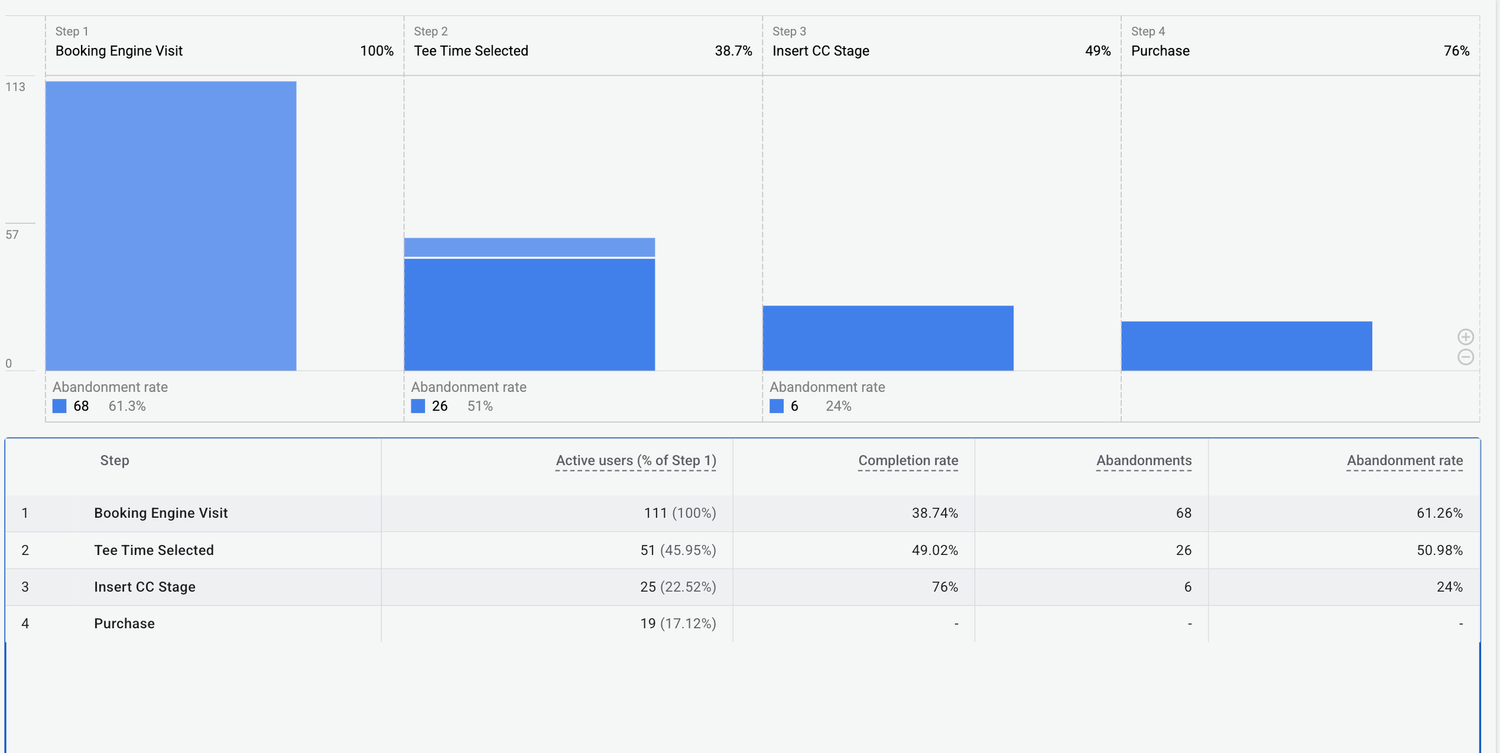
In this example, the biggest leak isn’t at checkout — it’s at the very top. Nearly 6 in 10 sessions (58.9%) never make it from landing on the page to actually selecting a tee time. Every step after that loses another meaningful chunk: 41.9% drop off before setting a player count, 32.6% before entering payment, and 20% abandon at payment itself.
That’s a useful chart. But a chart alone only gets an operator so far. To actually get value out of it, two things need to be true on the vendor side:
1. A real data dictionary. What exactly counts as “session start”? Does “abandonment” mean the golfer left the site, or just paused on that step? Without clear definitions, operators are left interpreting someone else’s numbers instead of trusting them.
2. Custom events for every meaningful click, not just step-level page views. Date picker interactions, time slot selection, player count adjustments, coupon entry, payment method selection — the more granular the tracking, the more precisely an operator can find where the friction actually is, instead of just knowing that it exists somewhere in the middle of the funnel.
Ask your booking engine vendor for both. If they can’t produce a data dictionary or explain what’s being tracked at the click level, you’re not getting the full value of the data you’re already generating.
We went deeper on exactly this — how to read your booking engine data and what to ask your vendor for — in the NGCOA webinar Measure What Matters: Selling Tee Times in 2026, hosted by Mike Hendrix on July 16, 2026.
🔎 Go deeper: three questions to ask your booking engine vendor
- Do you provide a data dictionary for every metric in our dashboard?
- Do you track custom events for individual clicks, or only step-level page views?
- Can we see abandonment broken out by device, referral source, and promotion?
Featured
Revolving Events Booking Engine
We built this one, and we think it’s worth showing off.
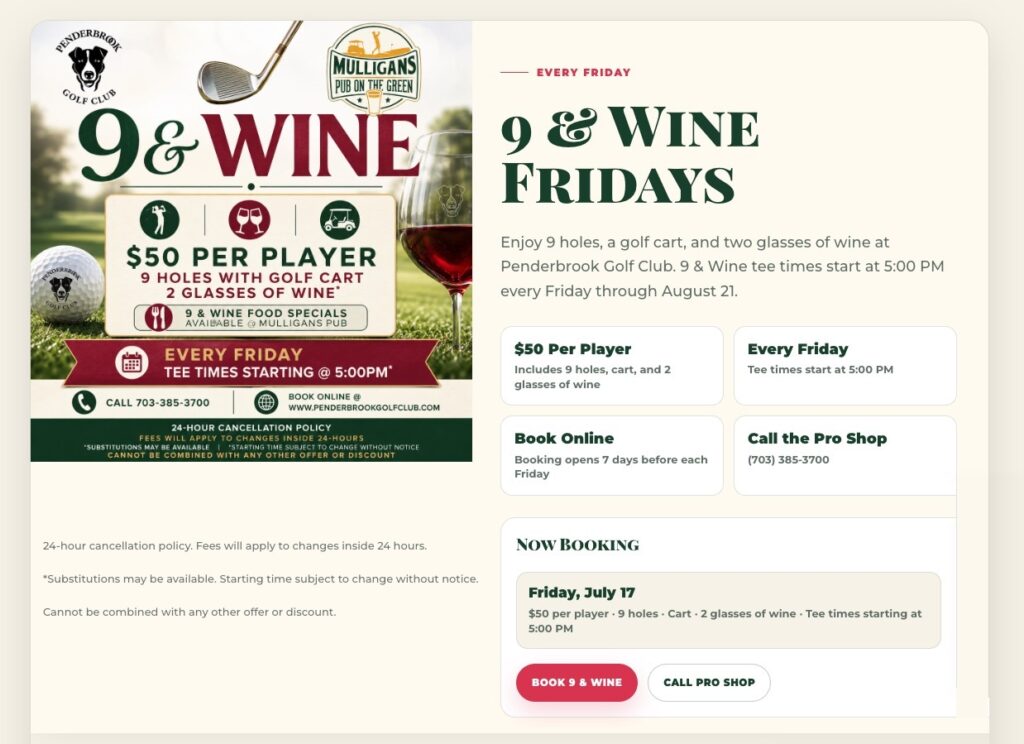
Take Penderbrook Golf Club’s 9 & Wine Fridays — 9 holes, a cart, and two glasses of wine for $50, every Friday at 5:00 PM through August 21. Booking opens 7 days before each Friday, which means the booking link’s date changes every single week.
Normally that’s a standing chore: someone on staff has to log in, find the old link, swap the date, and republish — every week, for as long as the promotion runs. Miss a week, and golfers land on a broken link or a page for a date that already passed.
The Revolving Events Booking Engine removes that chore entirely. The link on Penderbrook’s site automatically advances to the correct upcoming Friday, every time, with no one touching it.
Strategy note: This is what we mean when we say our tools are built in reality. Golf course teams are running a business, not a content calendar. A feature that requires perfect weekly follow-through to stay accurate isn’t really a feature — it’s a chore with a deadline. The Revolving Events Booking Engine removes the deadline.
Why this page works
It removes a recurring task instead of adding a dashboard: the link just stays correct, with nothing for staff to remember.
It protects trust in the promotion: golfers never hit a stale date or a dead link, which keeps a simple weekly special feeling reliable week after week.
It’s a small mechanism with real revenue behind it: a $50 recurring promotion only pays off if the booking link actually works every single time someone clicks it.
Get the next edition
Digital Hospitality in Golf is free and comes every other Wednesday. Each issue is one or two ideas your team can use.