How a Better Driving Range Page Helped EagleSticks Show Up in Google's AI-Assisted Results.
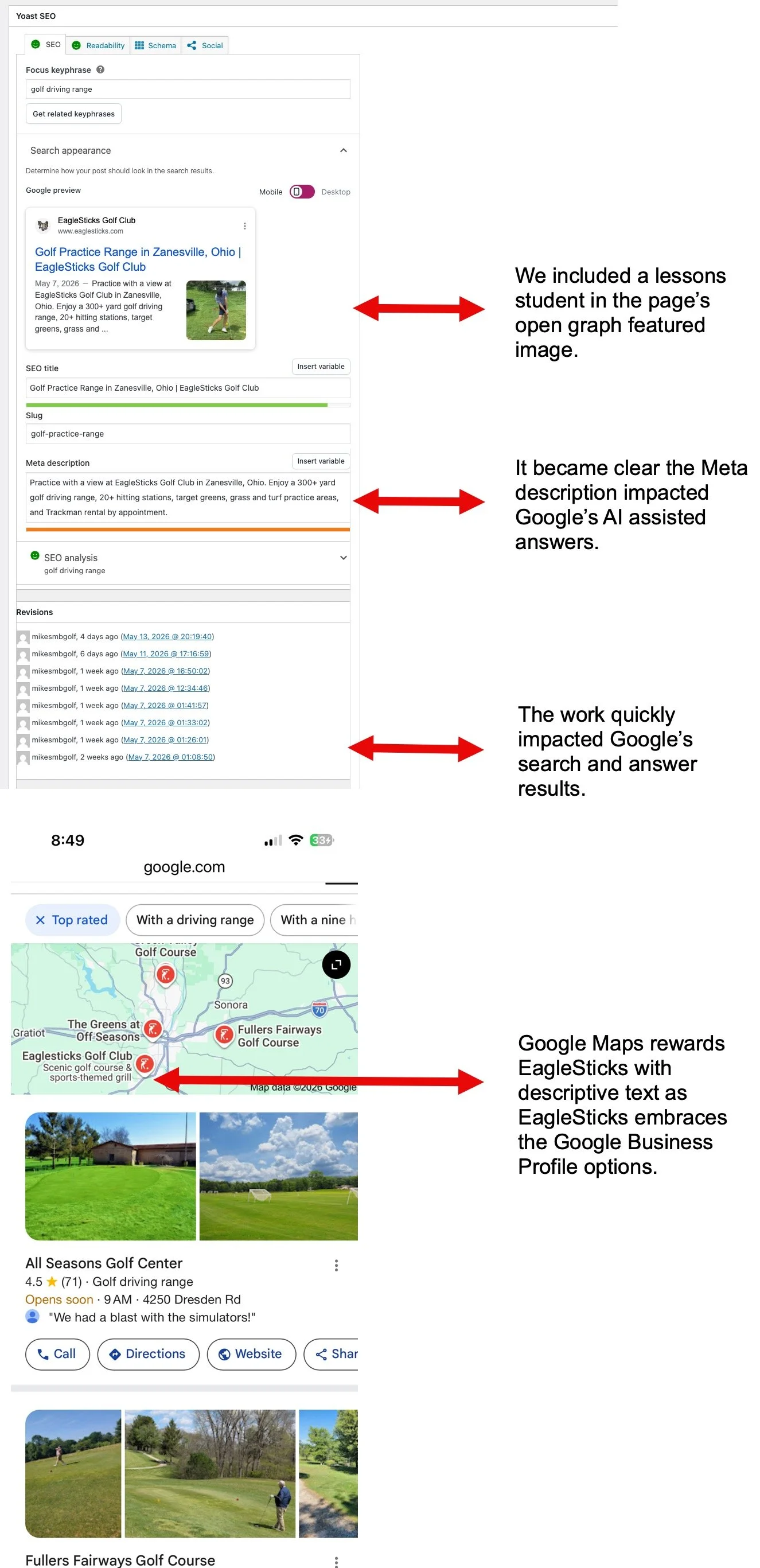
On May 7th, we put real work into improving the driving range page on the EagleSticks Golf Club website. By May 17, we were already seeing signs that the work was paying off.
A search for "best driving range in zanesville" included EagleSticks Golf Club in Google's AI-assisted results as one of the local options for golfers looking for a place to practice. The result referenced specific details about the practice experience — the quality of the teeing area, the number of hitting stations, and Trackman rental availability.
That matters.
Not because EagleSticks is only a driving range. It is not. EagleSticks Golf Club is a full golf club in Zanesville, Ohio, and the driving range is one of its many amenities. But that amenity has its own search demand, its own golfer intent, and its own revenue opportunity. Golfers are not always searching for a tee time. Sometimes they are searching for a place to practice, warm up, work on their swing, or use technology like Trackman.
The opportunity was simple: make the driving range easier for golfers to understand and easier for Google to understand.
This is what we call Hospitality First SEO.
Hospitality First SEO Starts with Digital Hospitality
At smbGOLF, we are building our work around one larger idea: Digital Hospitality.
Digital Hospitality is the belief that a golfer's experience with a golf course does not begin when they arrive in the parking lot. It begins much earlier — when they search on Google, visit the website, check the tee time page, read reviews, scan the menu, explore the scorecard, or try to decide whether the course is worth their time.
Every one of those moments is part of the golfer experience.
That is why the driving range page at EagleSticks matters. This was not just an SEO project. It was a Digital Hospitality project that used smart SEO strategy.
Traditional SEO can become too focused on keywords, rankings, plugins, and technical checklists. Those things matter, but they are not enough. A page can be technically optimized and still fail the golfer — leaving the visitor unsure, unimpressed, or one click away from choosing somewhere else.
Hospitality First SEO starts from a different place. It asks: What does the golfer need to know? Then: How do we make that answer clear for the golfer and easy for Google to understand?
For the EagleSticks driving range page, the goal was not to repeat "driving range in Zanesville" enough times. The goal was to help a golfer quickly understand why the EagleSticks practice experience is worth choosing. Can they hit driver? Are there enough hitting stations? Are there target greens? Is there grass and turf practice? Can they use Trackman?
Those are golfer questions. When the page answers them clearly, the website becomes more helpful. When the website becomes more helpful, the SEO work becomes more valuable. It does not replace good SEO strategy — it makes good SEO strategy work harder.
The Search Had Real Intent
A search for "best driving range in zanesville" is not an empty search. That golfer is likely trying to make a decision: Where can I practice today? Is there a range nearby where I can hit driver? Does the facility have grass tees or only mats? Can I use Trackman?
That is real intent. And for a golf course, real intent is where Digital Hospitality becomes revenue strategy.
A golfer searching for a driving range is already raising their hand. They may not be ready to book 18 holes, but they are interested in spending time at a golf facility. They may buy range balls. They may rent Trackman. They may visit the golf shop. They may grab food or a drink. They may come back later for a tee time, a lesson, or a membership conversation.
Too often, golf courses treat amenities like the driving range as secondary website content — mentioned on a general page, tucked into rates, or listed in a short sentence somewhere on the site. But golfers do not always search the way golf courses organize their websites.
A golfer does not think, "I need to find the amenities section." They think, "Where can I go hit balls?"
That is the question the EagleSticks page needed to answer. When a golf course understands the intent behind a search, the content gets better, the page becomes more useful, the calls to action become more natural, and the business opportunity becomes clearer.
Why We Chose "Golf Practice Range"
The EagleSticks driving range work started with a simple but important decision: the page needed to become a clear, focused destination. Not a buried mention. Not a short section on another page. A real page that could help golfers and Google understand the practice experience at EagleSticks Golf Club.
One of the first strategic choices was the URL slug. We chose /golf-practice-range.
We did not choose /golf-driving-range, even though "golf driving range" is a common Google search term. That decision was intentional.
Based on our research, one strong page could compete for both ideas: "golf driving range" and "golf practice range." The first phrase is closer to how many golfers search on Google. The second phrase is more intent-driven and better reflects the full experience EagleSticks offers.
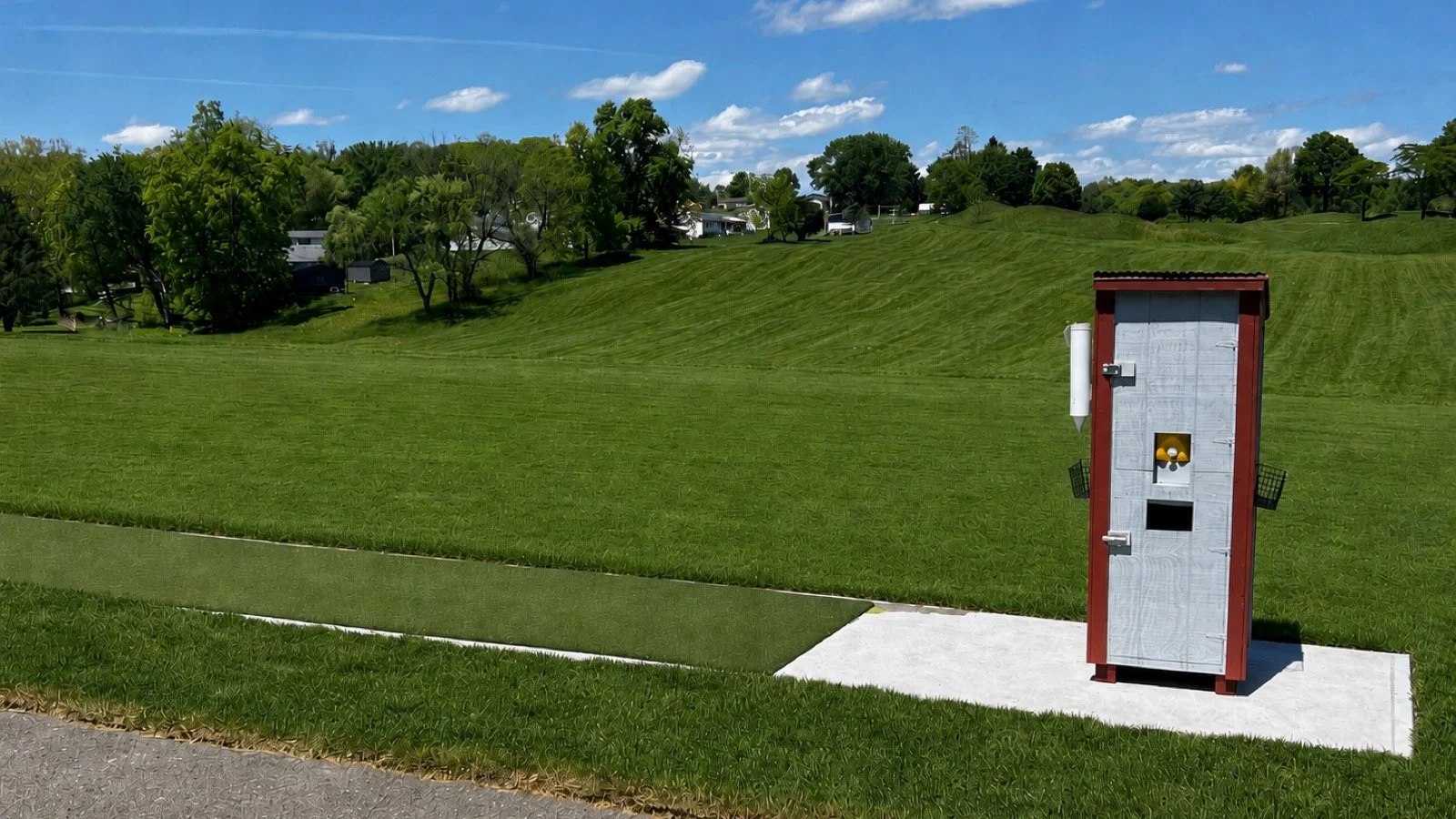
A golfer looking for a driving range may only be thinking about hitting balls. A golfer looking for a practice range may be thinking more broadly: warm-up, game improvement, target greens, grass practice, technology, and a better place to work on their game. EagleSticks does not simply have a place to hit golf balls — the club has a practice amenity that can support golfers before a round, between rounds, during lessons, or while using Trackman.
The phrase golf practice range gave us that flexibility while still supporting the more common driving range search behavior. It also gives EagleSticks room to build future supporting content around specific golfer questions — how to warm up before a round, how Trackman rentals work, why a better practice environment matters.
This page is not meant to stand alone forever. It is the foundation for a content cluster around the practice experience at EagleSticks.
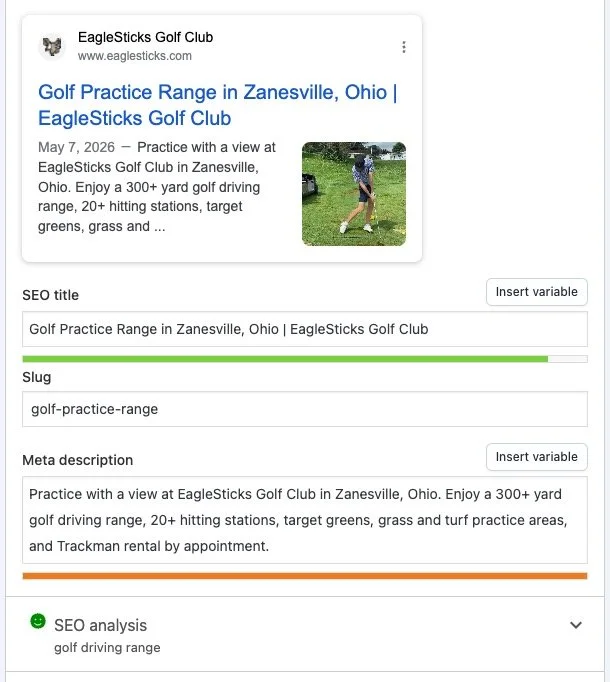
The page itself was strengthened with clear, specific information: a focused title, clean URL, useful metadata, and content highlighting the 300+ yard range, 20+ hitting stations, target greens, grass and turf practice areas, and Trackman rental by appointment. The goal was not to stuff every possible phrase onto the page — it was to build one strong, useful page that matched how golfers search and how EagleSticks wants its practice area to be understood.
Why Moving the Page Into the Main Menu Mattered
One of the quieter changes may end up being one of the most important: we moved the Driving Range page into the main website menu as its own top-level navigation item.
That may sound like a small website decision, but it fits perfectly with how the business of golf actually works.
A golf course is not always one simple business. It is often many businesses operating at one facility — the golf experience, the food and beverage operation, the driving range, the event venue, the golf shop, instruction, leagues, and more. Each one of those areas can have its own customer intent, search demand, revenue opportunity, and Digital Hospitality responsibility.
That is why top-level navigation matters. If a revenue center matters to the business, it should not be buried three clicks deep on the website. It should be easy for golfers, customers, and search engines to find, understand, and use.
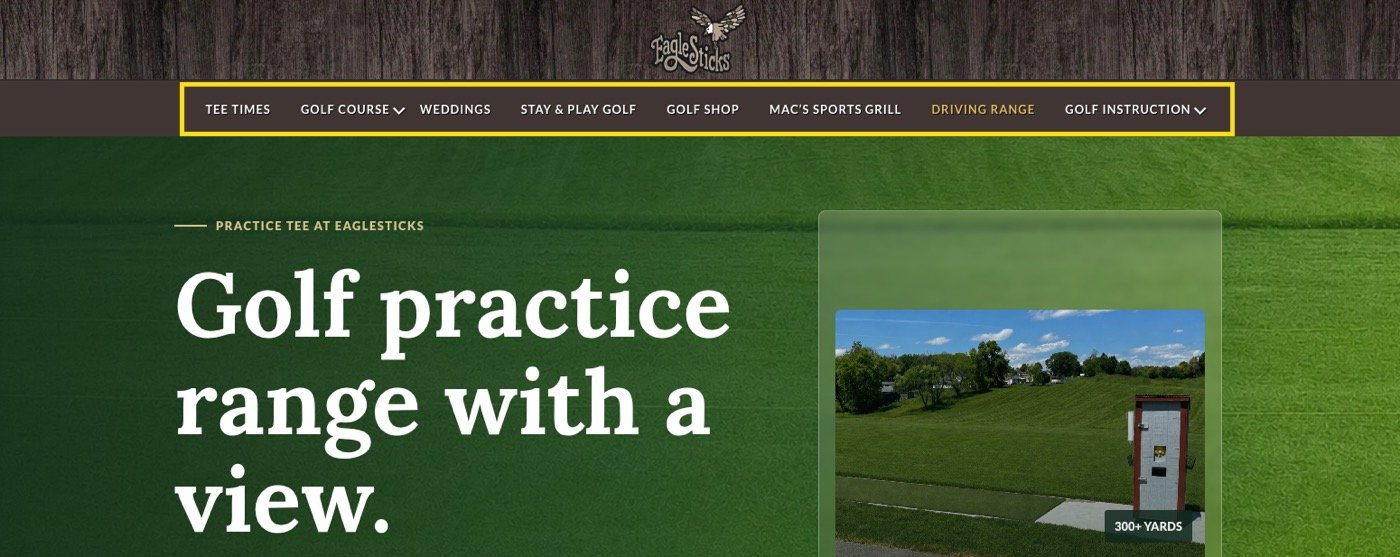
For EagleSticks, putting Driving Range in the main menu helps reduce friction. The golfer does not have to hunt. The golfer does not have to dig through unrelated information to find the answer they came for.
It also helps with search visibility. When a golf course builds strong, focused pages for each major part of the business, Google has clearer destinations to understand and present. The course is no longer relying on one homepage to explain everything. Each revenue center has its own page, topic, internal links, and opportunity to appear for relevant searches.
The facility already has the amenity. The golfer already has the intent. The revenue stream already exists. The website needed to give that revenue stream proper exposure.
What Google Appeared to Understand Quickly
By May 17, the early search results suggested Google was already beginning to understand the driving range page the way we intended.
That does not mean the page "caused" every result with absolute certainty. Search results are dynamic — they can change by location, device, search history, and timing. But the alignment was hard to ignore.
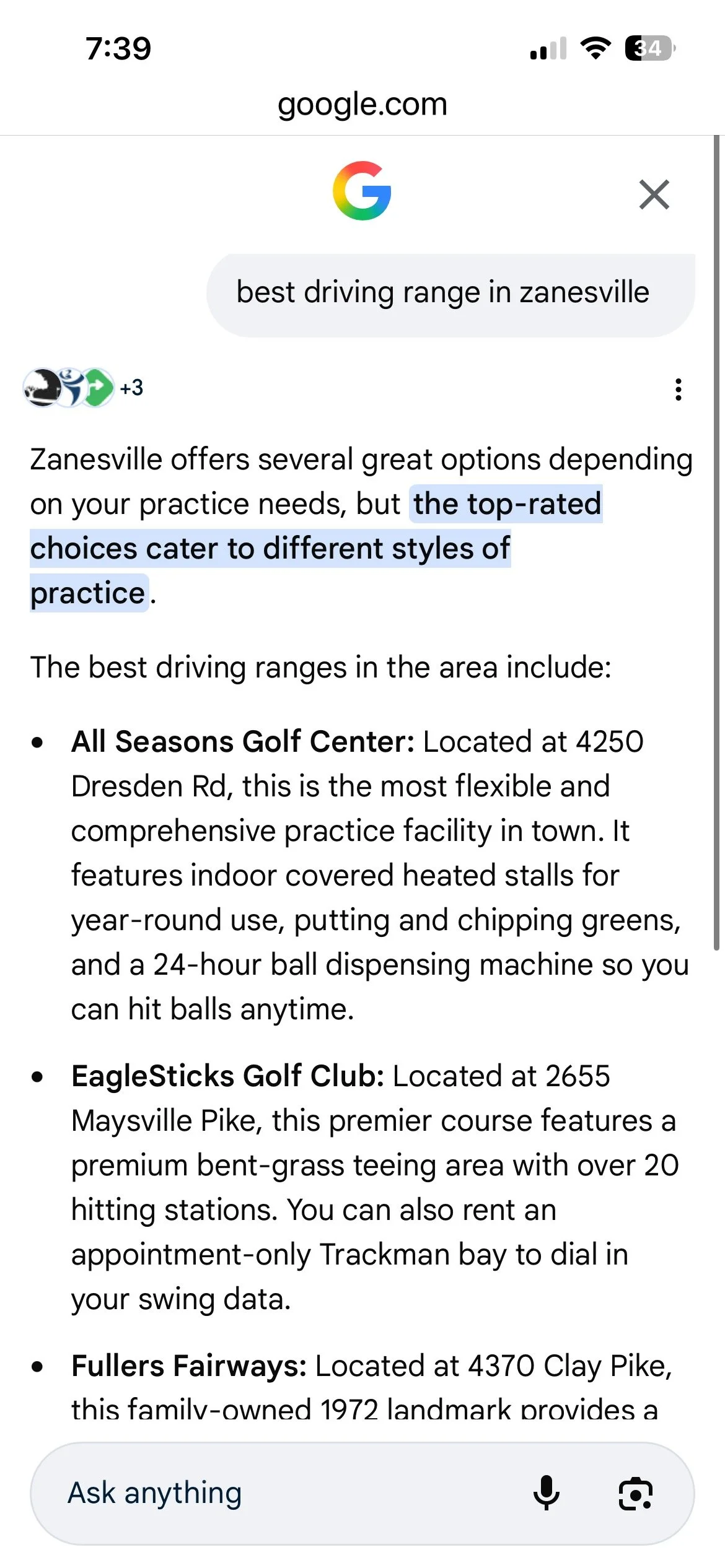
Less than two weeks after the page was improved, Google's AI-assisted results for "best driving range in zanesville" included EagleSticks Golf Club as one of the local options. The result referenced specific details that matched the improved page strategy: the quality of the practice area, the number of hitting stations, and the availability of Trackman rental by appointment.
That is exactly the kind of information we wanted Google to understand.
The traditional search result also reflected the work. The page preview showed language tied directly to the practice range experience — the 300+ yard driving range, 20+ hitting stations, target greens, grass and turf practice areas, and Trackman rental.
Google did not just find the page. Google appeared to understand the page. A golf course can have a page indexed and still fail to communicate what makes the amenity useful or worth choosing. In this case, the improved page gave Google a clearer set of signals: EagleSticks Golf Club is in Zanesville, it includes a driving range with specific features golfers care about, and the page is relevant to golfers looking for a place to practice.
The Webpage Did Not End the Strategy — It Expanded It
One of the best outcomes from the new driving range page is what it revealed about the larger opportunity at the facility level.
Once the driving range had a stronger digital presence, it became easier to see the next set of moves. The page clarified that the driving range is not just an amenity to mention in passing — it is a real revenue stream with its own customer intent and room for growth.
A better page can lead to better signage. Better signage can strengthen on-property awareness. Stronger on-property awareness supports a better Google Business Profile strategy. A better Google strategy creates more visibility in local map results. More visibility leads to more golfers finding the range, more practice sessions, and more bags of range balls sold.
The next phase of the EagleSticks driving range strategy may include clearer on-property signage, more supporting content around practice and Trackman, and exploring whether the driving range can eventually support its own nested Google Business Profile.
This connects directly to one of smbGOLF's core beliefs about Digital Hospitality: use the rules to your advantage. That means building toward a stronger profile properly — not forcing a separate listing before the real-world experience supports it. If EagleSticks wants to pursue a nested profile for the driving range, the facility should first make the range easier to recognize as a distinct public-facing part of the business: better signage, clearer naming, consistent schema, stronger internal links, and a tighter connection between what golfers see on property and what Google sees online.
That is not a shortcut. It is using the rules intelligently.
Why This Matters for Golf Courses
The EagleSticks driving range page is one example, but the lesson applies to almost every golf course.
Most golf facilities have more to offer than their website clearly explains. They may have a driving range, golf lessons, a restaurant, a golf shop, leagues, outings, junior programs, weddings, simulators, or membership options. But too often, those parts of the business are underrepresented online — buried inside one general page, mentioned in a few sentences, without their own search strategy or clear call to action.
That creates a Digital Hospitality problem.
If a golfer cannot easily understand what the facility offers, the course is making the golfer work too hard. If Google cannot clearly understand what the facility offers, the course may miss opportunities to appear in the right search results, map results, and AI-assisted answers.
Golfers do not always search for the business the way the business thinks about itself. A golf course may think of itself primarily as a place to play 18 holes. But a golfer may search for a driving range, a lesson program, a patio for lunch, a wedding venue, a junior golf program, or a place to practice before work. Each one of those searches represents a different need. Each may deserve a different digital front door.
The goal is not to create more pages for the sake of it. The goal is to make the golf course easier to understand, easier to trust, and easier to choose. When a golf course does that well, the website becomes more than a brochure. It becomes a source of truth for golfers, a stronger signal for Google, and a more useful tool for growing revenue across the entire facility.
If a part of the business matters in the real world, it should be easy to find, easy to understand, and easy to act on in the digital world.
More Visibility, Better Experience, More Revenue Opportunity
The driving range project at EagleSticks started with a webpage. But less than two weeks after improving the page, we were already seeing signs that Google was surfacing the information in relevant search experiences.
The larger value, though, is what the work revealed: the driving range deserves more attention, stronger visibility, clearer signage, supporting content, and a stronger Google Business Profile strategy. It deserves to be treated like what it is — a meaningful revenue stream inside the larger EagleSticks Golf Club business.
Good SEO can help a golf course get found. Hospitality First SEO helps a golf course get understood, chosen, and visited.
For EagleSticks, that means more golfers discovering the driving range, more confidence in the facility, and more opportunities to sell range balls, Trackman rentals, and future practice-related services.
The work is not finished. The improved page was just the beginning.