Digital Hospitality in Golf · Edition 5
Your booking engine has been live for years. So why is your phone still ringing?
That’s the exact question an operator asked me this week at the PGA Buying Summit in Frisco, Texas — and it’s the most honest question I’ve heard on this topic in a long time.
This week’s thought piece
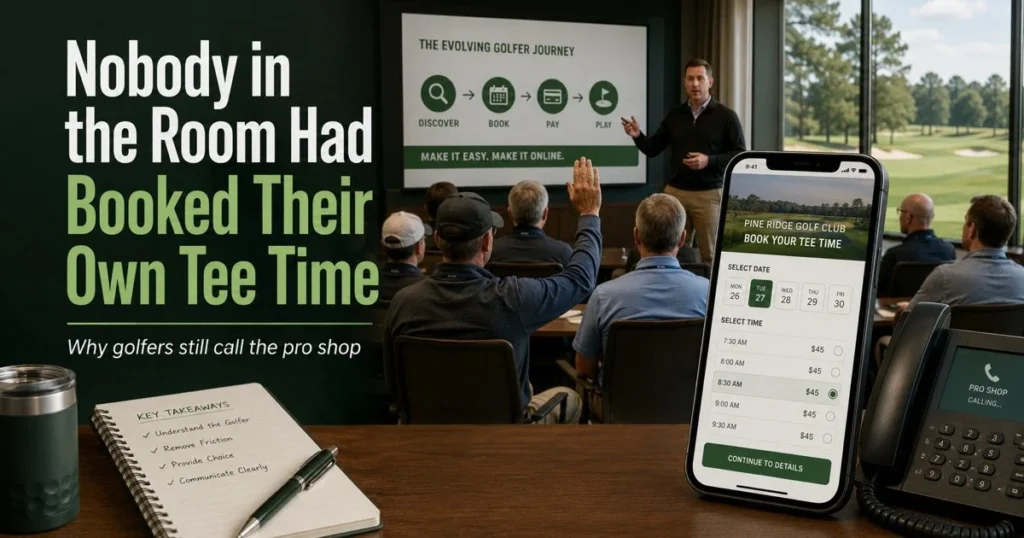
Nobody in the room had booked their own tee time.
I hosted an education session at the 2026 PGA Buying Summit called “Take Control of Your Digital Story in an AI Age.” Partway through, an operator raised his hand: “We offer online tee times and have for years. Why are the majority of my tee times still booked by phone?”
Here’s the honest answer: because most of us in golf did exactly what the tech reps told us to do. The pitch was simple — offer online tee times, and the phone will stop ringing. Almost nobody gave much thought to what it actually feels like for a golfer to book online.
So I asked the room a question back: “Who here has personally booked a tee time at their own facility, through their own booking engine, in the last three months?”
One hand went up. In a room full of the people responsible for that experience.
The homework I gave the room — and you.
Tonight, book a tee time at your own course, using your own booking engine, like a golfer would. Then ask yourself: Can you log in with a Google ID, the way you can on almost every modern app? Do you have to agree to terms and conditions before you even see inventory? How many screens stand between “I want to play Saturday” and “confirmed”?
Then ask the harder question: do you push your booking engine vendor the way you’d push any other vendor? Do you require performance reporting, or ask for better features on a schedule? For most operators, the honest answer is no — and that’s the real reason nothing improves. If the industry doesn’t push the vendor, the vendor has no reason to invest.
🔎 Go deeper: three questions to ask about your own booking engine — tonight, not someday
- Have I personally booked a tee time through my own booking engine in the last three months?
- Can a golfer log in with a Google ID, or are we still making them create a new account from scratch?
- Do I require performance reporting and feature commitments from my booking engine vendor — or have I just assumed it’s fine because nobody’s complained?
Featured
EagleSticks, Hole 6 — Two Pages, Two Jobs
Booking is only one moment. Here’s what we built for the other 18.
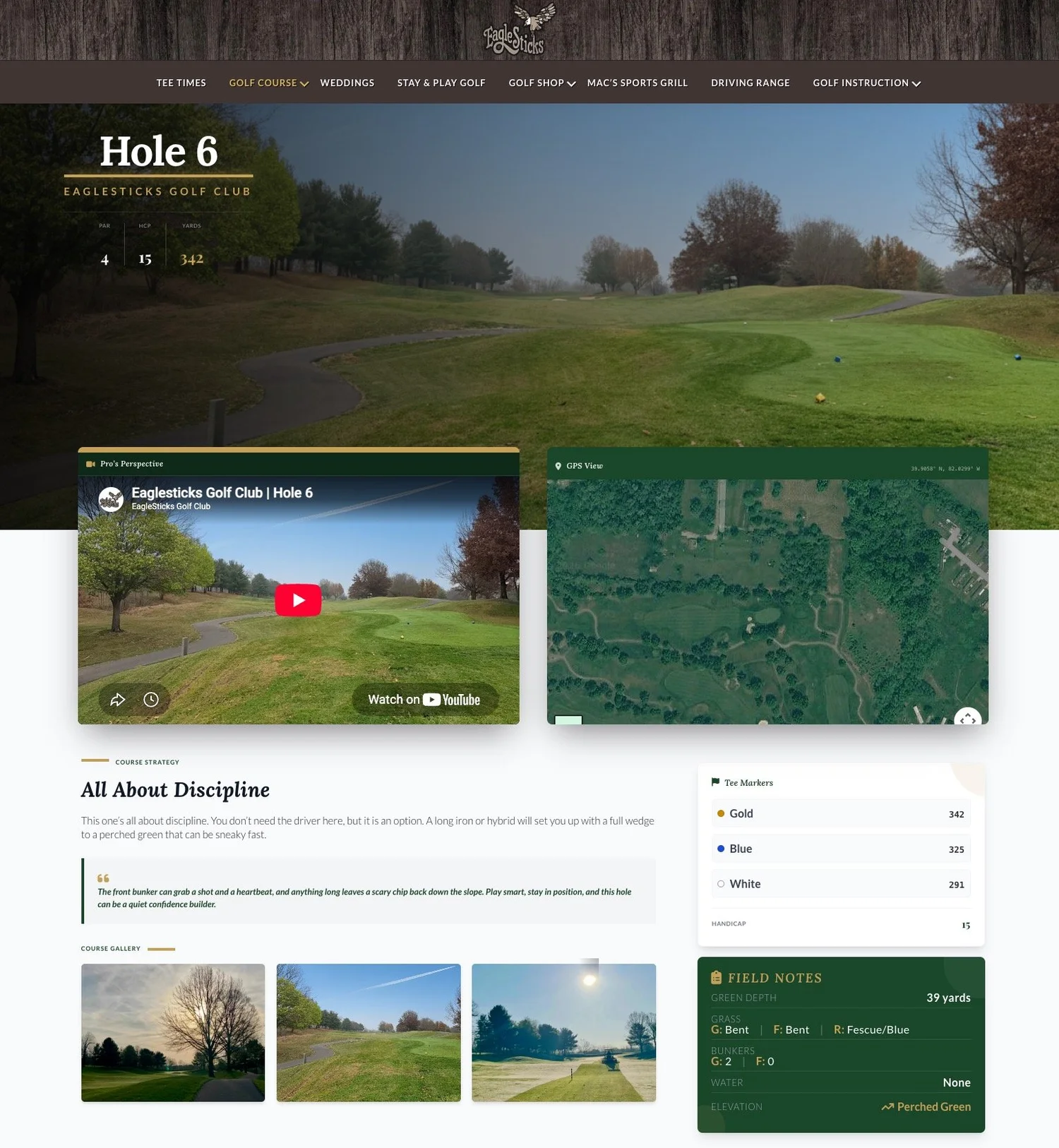
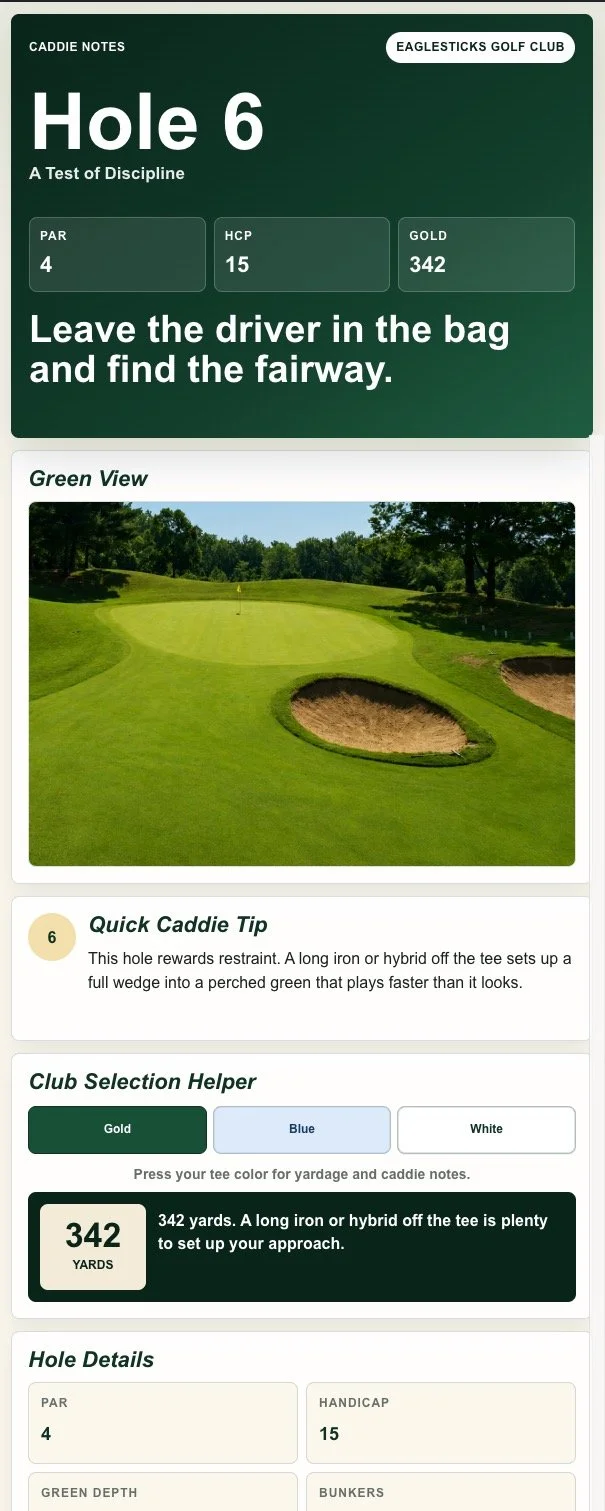
Hole 6 at EagleSticks is a 342-yard par 4 with a perched, fast green and two greenside bunkers. The marketing page sells that story for someone deciding whether to play the course. The Caddie Notes page is a different tool entirely — a Club Selection Helper lets a golfer on the actual tee box tap their tee color and get the exact yardage and strategy for their shot, alongside a Quick Caddie Tip, Field Notes, and Putting Tips.
Strategy note: This is Digital Hospitality applied on both sides of the round. The marketing page answers “why should I play this course.” The Caddie Notes page answers “what do I do on this hole, right now.” Neither one should try to do the other’s job — and most courses only have the first one.
Why the split works
It matches the device to the moment: a golfer researching a course from home has a browser and time; a golfer on the tee has one hand and three seconds.
It answers a real decision, not a trivia fact: on the course, a golfer needs to know what to hit, not how far it is on a satellite map.
It adjusts to the golfer, not the other way around: tapping a tee color changes the advice, instead of forcing every golfer to translate one generic number into their own game.
It travels with the golfer: the Caddie Notes page is light enough to sit on a phone in a cart, turning “hole by hole” from a page nobody revisits into a tool somebody actually uses mid-round.
Get the next edition
Digital Hospitality in Golf is free and comes every other Wednesday. Each issue is one or two ideas your team can use.